Over-billing is rarely deliberate. Claim 3 gets built from a copy of claim 2's sheet. Someone types 80% when the job is only at 70%. A variation is billed before anyone approved it. A red warning sits at the bottom of the sheet and the claim goes out anyway.
I think a contract should bill its value to the fil, and a claim that would go past it should not be possible to issue at all. It sounds strict, but it saves the awkward call where you explain to a main contractor why the last claim has to be credited back.
What counts toward the 100%
On the reference contract (1,000,000 before VAT, a 30% advance, 10% retention, work billed 30%, 40% and 30%) the 100% is measured on the work certified on each claim, before the advance and the retention come off. 300,000 + 400,000 + 300,000 = 1,000,000, and the contract is done.
The advance tax invoice is not counted again, because it is money received early and taken back out of the claims. The retention release is not counted again either, because it pays out what the claims already certified. A draft does not count until it is issued. A credit note counts, as a minus.
- Claim 1 (30%)300,000.00
- Claim 2 (40%)400,000.00
- Claim 3 (30%)300,000.00
- Advance tax invoice300,000.00
- Claim 1180,000.00
- Claim 2240,000.00
- Claim 3180,000.00
- Retention release100,000.00
Look at it document by document and it still adds up. Before VAT, the advance bills 300,000, the claims bill 180,000, 240,000 and 180,000 net, and the release bills 100,000. That is 1,000,000.
The fourth claim, and the 80% that should have been 70%
After claim 3 there is nothing left to bill. A fourth claim of any amount, even one fil, takes the contract over 100%, so it is refused. The same check catches the more common mistake earlier in the job: after claim 1, 700,000 is left, and a claim typed at 80% would take the contract to 1,100,000.
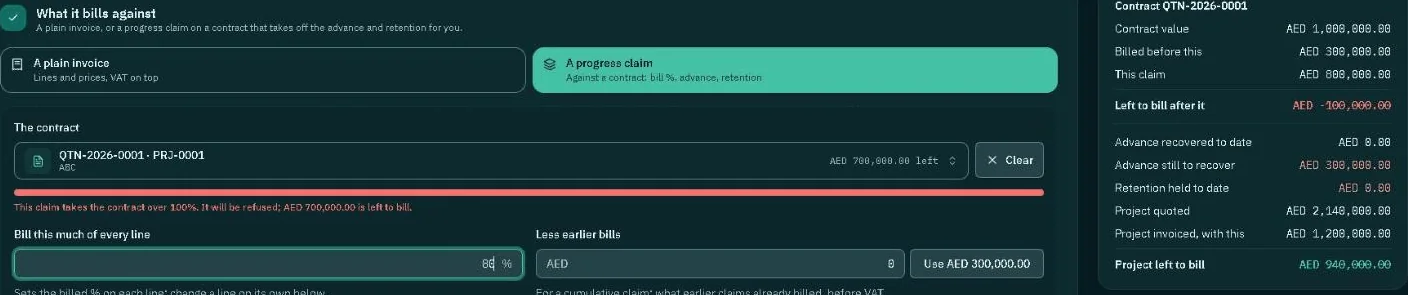
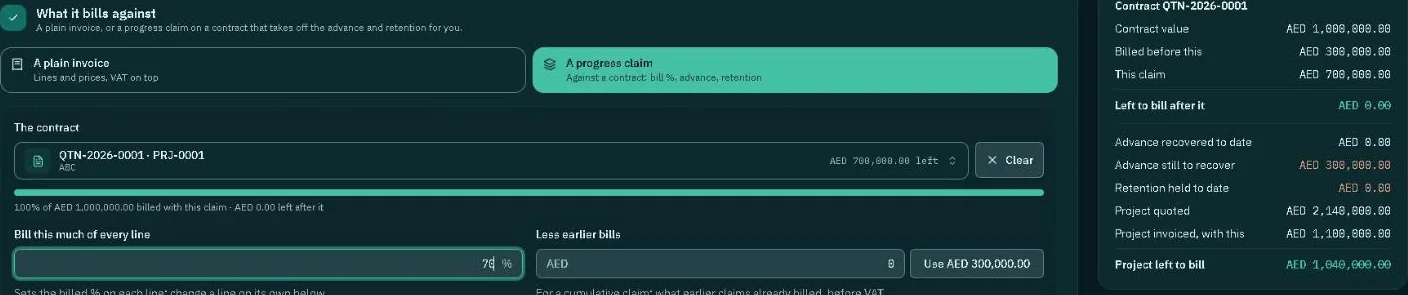
The limit is exact. The last claim lands on 100% and anything above it is over, with no tolerance to hide a few hundred dirhams in. It should be checked when the claim is saved and again when it posts, so two drafts that each fit on their own cannot both reach the books.
One thing the limit must never do is stop a correction. If a contract is already over 100% (an old job, or a variation withdrawn after it was billed), lowering a draft claim has to stay possible. Only an increase is refused.
VAT across the contract: exactly 5%
If the contract bills exactly 1,000,000, the VAT declared across it is exactly 5%: 50,000, each fil once. The documents carry different shares under each method, but the total does not move.
| Document | Before VAT | After VAT |
|---|---|---|
| Advance tax invoice | 15,000.00 | 15,000.00 |
| Claim 1 | 9,000.00 | 10,500.00 |
| Claim 2 | 12,000.00 | 14,000.00 |
| Claim 3 | 9,000.00 | 10,500.00 |
| Retention release | 5,000.00 | 0.00 |
| Total | 50,000.00 | 50,000.00 |
The only difference allowed is rounding. VAT is rounded on each tax invoice, so retention released in three parts can bring the total to 50,000.01: a difference of fils, never of dirhams. If the total is off by more than that, look for the advance's VAT declared twice, or a release without its VAT.
Stages: each one bills up to its quantity
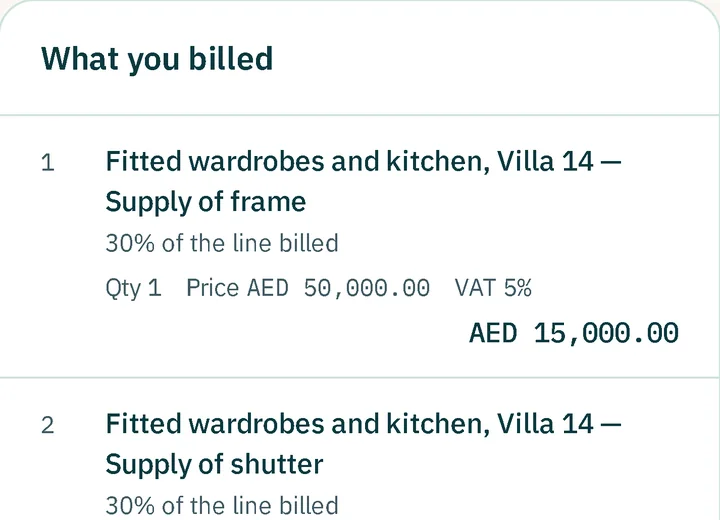
The 100% works on the whole contract. Joinery needs the same discipline line by line, because a line is often billed in stages: frames first, then leaves, then fixing.
Take 25 wooden doors at 4,000.00 each, 100,000.00 for the line, split into stages by their share of the price. Every stage covers the same 25 doors.
| Stage | Share of the price | Worth for 25 doors |
|---|---|---|
| Frame | 15% | 15,000.00 |
| Door leaf | 35% | 35,000.00 |
| Architrave | 10% | 10,000.00 |
| Fixing | 20% | 20,000.00 |
| Ironmongery | 15% | 15,000.00 |
| Final touch-up | 5% | 5,000.00 |
| The line | 100% | 100,000.00 |
Claim 1 bills all 25 frames: 25 × 4,000.00 × 15% = 15,000.00. If claim 2 bills 25 frames again, that is 50 frames on a line of 25 doors. The claim total might still be under 100% of the contract, which is exactly why the stage needs its own limit. Mizarah refuses that save and names the stage: Frame (would bill 50 of 25).
A line billed without stages is held to its agreed value instead, with a small allowance for rounding on the last bill.
Variations move the 100%
A contract rarely stays the size it was signed at. The client adds a reception desk, the contract grows from 1,000,000 to 1,150,000, and every claim from then on is measured against the larger figure. An omission is a variation too, and it makes the contract smaller.
| Line | Amount |
|---|---|
| Contract as signed | 1,000,000.00 |
| Approved variation: reception desk | 150,000.00 |
| Contract sum now | 1,150,000.00 |
| Work billed on claims 1 to 3 | 1,000,000.00 |
| Left to bill | 150,000.00 |
Only an approved variation counts. One that is still being argued about does not move the limit, and one that is rejected or withdrawn stops counting. That keeps the 100% honest in both directions: you cannot bill a variation nobody agreed, and a legitimate final claim against an approved one is not flagged as over-billing.
Claimed is not certified
You claim 200,000. The client's QS walks the site and certifies 180,000. You are paid on 180,000. The other 20,000 is carried to the next claim or argued about.
Keep both numbers. If you edit the claim down to 180,000 and throw the 200,000 away, the next conversation with the client starts without the figure it is about. And put only the certified figure in your books as revenue. Posting the full claim overstates what you are owed by every amount the QS cut.
When I was chasing payments on WhatsApp, the gap between claimed and certified was behind a lot of the slow ones. Our invoice said one figure, their certificate said another, and "which bill?" usually meant "which number?" A claim that matches the certificate tends to get paid without a long thread.