I spent 13 years running a joinery workshop in the UAE. Our progress claims went out from an Excel sheet, and every so often the main contractor's QS sent one back with the VAT worked out differently from ours.
Nobody was being careless. There are two ways to do this sum, both of them consistent, and a claim sheet that has been copied forward month after month tends to pick up a bit of each. That third version is the one that causes trouble, and it rarely shows on the claim itself.
Two methods, and every deduction follows one
Deductions before VAT: take the advance, the retention and any other deduction off the work, then add 5% on what is left. Deductions after VAT: add 5% on the whole of the work first, then take every deduction off the total including VAT.
The part people skip is "every deduction". The advance recovery, the retention, earlier bills, a discount and a penalty you typed in yourself all follow the same method on the same invoice. You do not get to pick per line.
| Before VAT | After VAT | |
|---|---|---|
| Order | Work less deductions = net, then VAT on the net | VAT on the work first, then deductions off the total including VAT |
| A % deduction | % of the work before VAT | % of the total including VAT |
| A fixed amount | Read as an amount before VAT | Read as an amount including VAT |
| An earlier invoice deducted | At its net value (received 105, deduct 100) | With its VAT (10 net deducted as 10.50) |
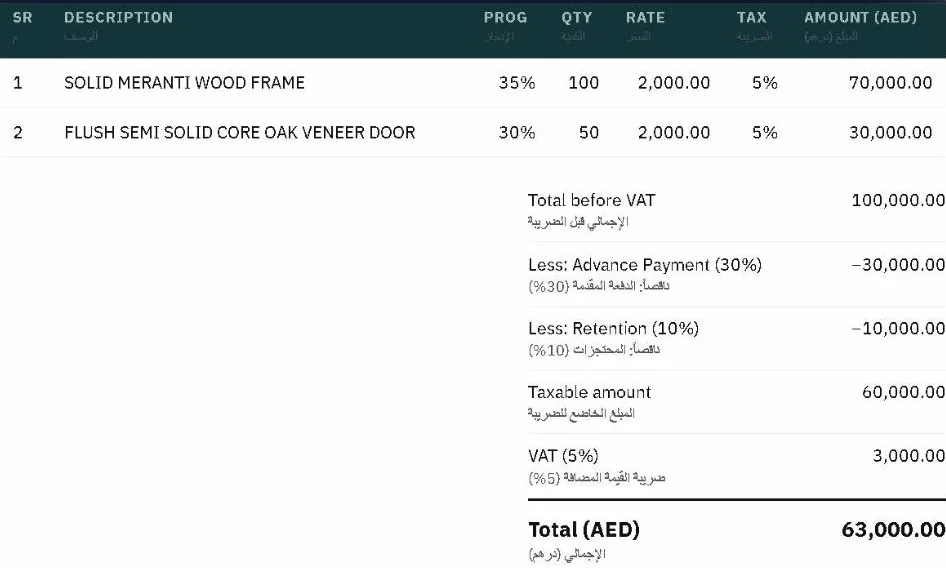
The smallest example I know is a claim of 100 with a 30% advance and 10% retention. Before VAT: 100 less 30 less 10 is 60, plus 3 of VAT, so 63 to pay. After VAT: 100 plus 5 is 105, less 31.50 and 10.50, so 63 to pay.
- Work certified100.00
- −Advance 30%30.00
- −Retention 10%10.00
- =Taxable amount60.00
- +VAT 5%3.00
- =Payable63.00
- Work certified100.00
- +VAT 5%5.00
- =Including VAT105.00
- −Advance 30%31.50
- −Retention 10%10.50
- =Payable63.00
Same 63, but not the same VAT on the invoice. Before VAT the claim declares 3.00. After VAT it declares 3.50: 5.00 on the work, less the 1.50 already declared on the advance. The missing 0.50 is the retention's VAT, and the before-VAT method declares it later, at the release.
One contract, worked both ways
This is the contract we test Mizarah against: 1,000,000 before VAT, a 30% advance, 10% retention, and the work billed 30%, 40% and 30%.
| Document | Calculation | VAT declared | Payable |
|---|---|---|---|
| Advance tax invoice | 300,000 + VAT | 15,000.00 | 315,000.00 |
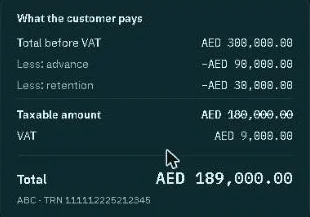
| Claim 1 | 300,000 − 90,000 − 30,000 = 180,000, + VAT | 9,000.00 | 189,000.00 |
| Claim 2 | 400,000 − 120,000 − 40,000 = 240,000, + VAT | 12,000.00 | 252,000.00 |
| Claim 3 | 300,000 − 90,000 − 30,000 = 180,000, + VAT | 9,000.00 | 189,000.00 |
| Retention release | 100,000 + VAT | 5,000.00 | 105,000.00 |
| Total | Net 1,000,000 | 50,000.00 | 1,050,000.00 |
| Document | Calculation | VAT declared | Payable |
|---|---|---|---|
| Advance tax invoice | 300,000 + VAT | 15,000.00 | 315,000.00 |
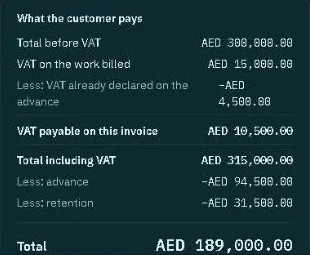
| Claim 1 | 315,000 − 94,500 advance − 31,500 retention | 10,500.00 | 189,000.00 |
| Claim 2 | 420,000 − 126,000 − 42,000 | 14,000.00 | 252,000.00 |
| Claim 3 | 315,000 − 94,500 − 31,500 | 10,500.00 | 189,000.00 |
| Retention release | 105,000, VAT already declared | 0.00 | 105,000.00 |
| Total | Net 1,000,000 | 50,000.00 | 1,050,000.00 |
After VAT, a claim declares the VAT on its work less the VAT already declared on the advance it takes back: on claim 1, 15,000 − 4,500 = 10,500.
Both methods end in the same place. The contract bills 1,000,000, declares 50,000 of VAT and collects 1,050,000. The advance account and the retention account both finish at zero, and a fourth claim has nothing left to bill. What moves is the retention's VAT: before VAT it waits for the release, after VAT it is declared on each claim.
Where they part: fixed amounts
With percentages the two payables match, as above. With fixed amounts they do not, and you should not try to force them to.
Say a claim of 1,000,000 recovers a fixed 300,000 of advance and holds a fixed 100,000 of retention. Before VAT, those two figures are amounts before VAT. After VAT, the same two typed numbers are amounts including VAT.
| Line | Before VAT | After VAT |
|---|---|---|
| Work certified | 1,000,000.00 | 1,000,000.00 |
| VAT on the work | — | 50,000.00 |
| Less advance | −300,000.00 | −300,000.00 |
| Less retention | −100,000.00 | −100,000.00 |
| VAT on the net | 30,000.00 | — |
| Payable | 630,000.00 | 650,000.00 |
The 20,000 gap is not an error. After VAT, the 300,000 you typed already contains 14,285.71 of VAT, so only 285,714.29 of advance comes off the work. The claim declares 35,714.29 of VAT: 50,000.00 on the work, less the 14,285.71 inside the advance. Before VAT it declares 30,000.00, 5% of the 600,000 left.
So when a main contractor tells you to "take 300,000 off", ask which method their certificate uses before you type it. The same number means a different deduction in each.
What a mix looks like, and where it breaks
The usual mix takes the advance off before VAT and leaves the retention inside the VAT base. It looks reasonable on a single claim. Here it is on claim 1 of the reference contract, next to the two honest methods:
| Method | VAT on the claim | Payable |
|---|---|---|
| Before VAT | 9,000.00 | 189,000.00 |
| After VAT | 10,500.00 | 189,000.00 |
| Mixed: advance before, retention after (wrong) | 10,500.00 | 190,500.00 |
190,500 matches neither method. Whichever one the main contractor certifies under, the certificate says 189,000 and your invoice says 190,500. The extra 1,500 is VAT on retention the client has not paid you, and will not pay you until the release.
You can see that one on the day. The bigger problem waits for the end of the job. Across the three claims the mix declares 35,000 of VAT, which already includes the retention's VAT, while the 100,000 of retention sits in your books at its value without VAT. Months or years later, someone has to raise the release, and both standard ways of doing it are wrong:
- Raised the before-VAT way, the release is 100,000 plus 5,000 of VAT. The retention's VAT has now been declared twice, and the contract declares 55,000 in total: 5.5% of its value.
- Raised the after-VAT way, the release asks for 105,000 with no VAT. That is 5,000 more than was ever held back.
The only right release for that contract is 100,000 with no VAT, which is a document neither method produces. By then the person raising it is often working from a sheet that does not say how the claims were done. So the claims look fine for the whole job, and the VAT return goes wrong in the period of the release.
Which method should you use?
Both are consistent. My own rule of thumb: use the method your contract and your main contractor's certificates already use, so your invoice and their certificate agree line by line, and confirm it with your tax agent. Then keep to it for every invoice on that contract.
Write down which method each contract uses, in the contract file and not only in the sheet. The release depends on it, and the release is the document most likely to be raised by someone who never saw the claims.
To see one of your own bills both ways before you decide, the free progress bill calculator works out a single claim under either method. The guide to VAT on progress claims has the same rules in short form.