The advance is a good day on a job. The quotation is approved, the client transfers 30%, and the workshop can order material. It is also the day the VAT starts, and that part is easy to miss in the rush.
An advance gets touched twice. Once when it comes in, and then again, in pieces, on every claim that takes it back. Each of those touches is a chance to declare its VAT a second time, and on a 1,000,000 contract the advance's VAT alone is 15,000.
Receiving the money is the tax point
Under the UAE VAT law, the date of supply is the earliest of several events, and one of them is the date you receive payment (Article 25 of the VAT Decree-Law). So an advance received before any work starts puts its VAT in the period you receive it.
A tax invoice is due within 14 days of the date of supply (Article 67). For an advance that is an advance tax invoice: the amount received, 5% VAT on it, your TRN, your client's TRN if they have one, the date, and what the money is for. The FTA's guide to tax invoices lists everything a tax invoice must show.
| Line | Amount |
|---|---|
| Advance payment (30%) | 300,000.00 |
| VAT (5%) | 15,000.00 |
| Total (AED) | 315,000.00 |
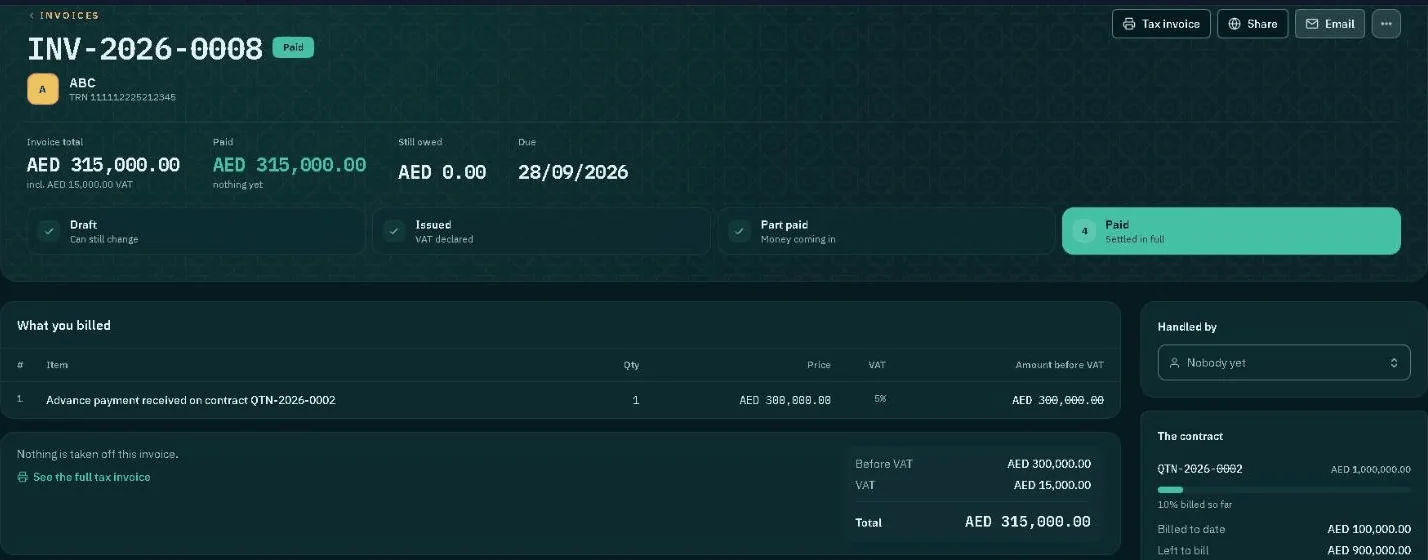
Nothing has to be delivered first. On an approved quotation the advance is invoiced when it is received. The usual slip is to bank the money as a deposit and leave the paperwork for the first claim. The VAT then lands in the wrong period, and the first claim gets more complicated than it needs to be.
In the books, the advance is not income yet. It is work you owe the client, so it sits in an advances account of its own. Every claim brings that balance down by the share it recovers, and when the last claim has taken its share the account is at zero. If it is not, either a claim forgot to deduct the advance or one took too much.
Taking it back, deductions before VAT
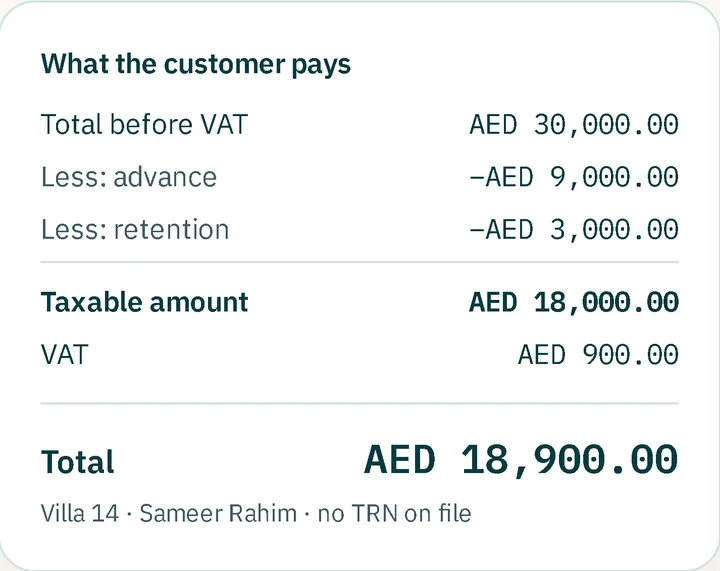
Each progress claim recovers a share of the advance until all of it is back. With deductions before VAT, the advance comes off at its net value. On a 300,000 claim with a 30% advance that is 90,000, not 94,500. Its VAT was declared on the advance tax invoice, so it stays out of this claim's VAT altogether.
| Line | Amount |
|---|---|
| Work certified | 300,000.00 |
| Less advance (30%) | −90,000.00 |
| Less retention (10%) | −30,000.00 |
| Taxable amount | 180,000.00 |
| VAT (5%) | 9,000.00 |
| Payable | 189,000.00 |
The mistake to watch for is deducting 94,500, the advance with its VAT, on a claim done before VAT. The 4,500 of VAT then comes off twice: once by staying out of the taxable amount, and again as money.
Three quick checks on any claim that takes back an advance:
- The share is worked out on this claim's work, not on the contract: 30% of 300,000, not 30% of 1,000,000.
- It never takes back more than is left. On this contract, 300,000 in total across all the claims, before VAT.
- The advance's VAT is not charged again. Before VAT it stays out of the taxable amount; after VAT it is subtracted from the VAT the claim declares.
Taking it back after VAT: the VAT already declared
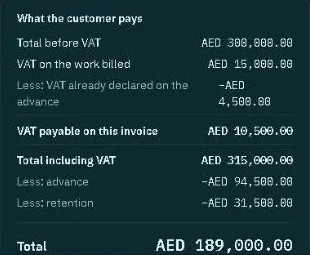
With deductions after VAT, VAT is worked out on the whole claim first, and the advance comes off with its VAT: 94,500 on the same 300,000 claim. Now the claim has to say clearly how much VAT it is declaring, because it is not the 15,000 on the work. 4,500 of that was declared on the advance tax invoice when the money arrived.
So the claim declares the VAT on the work less the VAT already declared on the advance it takes back: 15,000 − 4,500 = 10,500. That is the figure for your VAT return. On a smaller claim of 30,000, the tax invoice reads like this:
| Line | Amount |
|---|---|
| Total before VAT | 30,000.00 |
| VAT (5%) on 30,000.00 | 1,500.00 |
| Less: VAT already declared on the advance tax invoice | −450.00 |
| VAT payable on this invoice | 1,050.00 |
| Total including VAT | 31,500.00 |
| Less: Advance payment (30%) | −9,450.00 |
| Less: Retention (10%) | −3,150.00 |
| Total | 18,900.00 |
Two things add up on that page, and I would check both by hand once. The tax block: 1,500 − 450 = 1,050. The money: 30,000 + 1,500 − 9,450 − 3,150 = 18,900. If either does not foot, something on the invoice is wrong.
The expensive version of this mistake is a claim that charges VAT on the whole work and takes the advance back at only its net value. Across the 1,000,000 contract that declares 65,000 of VAT, 6.5%, because the advance's 15,000 is declared twice, and the client pays 15,000 more than the contract plus VAT.
The whole contract: 50,000, each fil once
- Advance tax invoice15,000.00
- Claim 19,000.00
- Claim 212,000.00
- Claim 39,000.00
- Retention release5,000.00
- Advance tax invoice15,000.00
- Claim 1 (15,000 − 4,500)10,500.00
- Claim 2 (20,000 − 6,000)14,000.00
- Claim 3 (15,000 − 4,500)10,500.00
- Retention release0.00
Before VAT, the claims declare 9,000, 12,000 and 9,000, and the retention release declares 5,000. After VAT, the claims declare 10,500, 14,000 and 10,500, and the release declares nothing. Add the advance's 15,000 to either set and you get 50,000: 5% of the contract, declared once.
That total is the quickest test I know. If your contract shows 65,000, the advance's VAT has gone in twice. If it shows 35,000 under after VAT, the claims subtracted the advance's VAT but no advance tax invoice ever declared it. If it shows 45,000 under before VAT, the retention release went out without its VAT.
A bill the client can follow gets paid
Over the years I chased a lot of payments on WhatsApp. Most of the slow ones were not refusals. The bill was unclear: the advance was not shown, the retention was missing, or the VAT was on a different figure from the one the client's QS had used. "Which bill?" came back more often than "no".
A claim that shows the advance it takes back, at the right value, with the VAT already declared named on the page, is a claim the other side can check in a minute, and in my experience that does more than a reminder ever did.