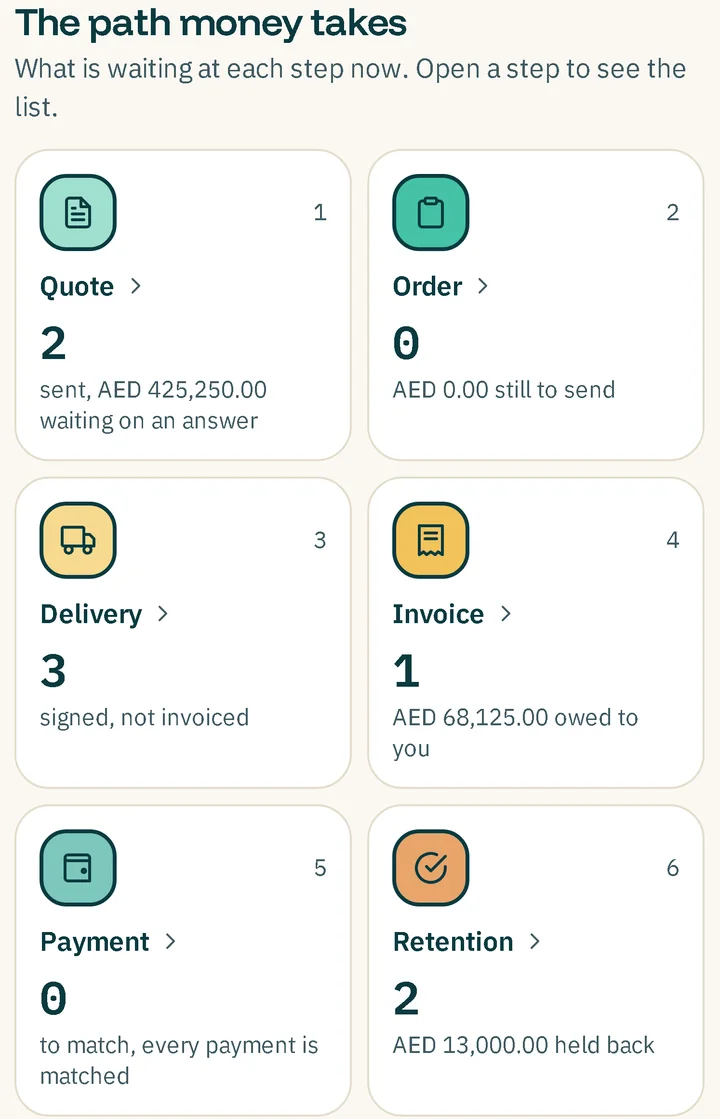
Retention is the money that comes back last. Part of it after handover, the rest after the defects period, and sometimes in pieces nobody planned for. By the time the release invoice is due, the person who raised the claims may have moved on, and the sheet that tracked the retention is several versions old.
That release invoice has one question on it that decides whether your VAT is right: does it carry VAT? The answer was settled on the claims. You just have to know how they were done.
Two ways to hold it back
Every claim follows one method for all of its deductions, and retention is one of them.
- Deductions before VAT: the retention comes off the work before VAT is worked out. The claim charges no VAT on it, so what you are holding back is a net amount.
- Deductions after VAT: VAT is worked out on the whole claim first, then the retention comes off with its VAT. The claim declares the retention's VAT, so what you are holding back already includes it.
| Claim | Held, before VAT | Held, after VAT |
|---|---|---|
| Claim 1 | 30,000.00 | 31,500.00 |
| Claim 2 | 40,000.00 | 42,000.00 |
| Claim 3 | 30,000.00 | 31,500.00 |
| Held at handover | 100,000.00 | 105,000.00 |
After VAT each figure includes 5%: the 1,500, 2,000 and 1,500 of VAT inside them were declared on those claims.
Before VAT: the release is where the VAT is declared
The retention was held without VAT, so its VAT has never been declared anywhere. The release is a tax invoice for the retention plus 5%: 100,000 + 5,000 = 105,000. Its tax point is the release date, so its VAT goes in the return for the period you release it, whenever that is.
| Line | Amount |
|---|---|
| Retention released | 100,000.00 |
| VAT (5%) | 5,000.00 |
| Total (AED) | 105,000.00 |
It is a tax invoice like any other: numbered in your normal invoice sequence, with your TRN, your client's TRN if they have one, and the date. The only unusual thing about it is that the work it taxes was finished long ago.
Raise this release without VAT and 5% of the retention is never declared at all. This is the "not at all" half of the problem, and the easier half to miss, because a release with no VAT looks tidy on paper.
After VAT: the release carries none
Here the retention's VAT was declared on each claim as it went: 1,500 on claim 1, 2,000 on claim 2 and 1,500 on claim 3. The release asks for the 105,000 that was held back, VAT included, and declares nothing. Put VAT on it again and the same 5,000 is declared twice.
- On the three claims0.00
- On the release tax invoice5,000.00
- Claim 11,500.00
- Claim 22,000.00
- Claim 31,500.00
- On the release0.00
| Line | Before VAT | After VAT |
|---|---|---|
| Retention released | 100,000.00 | 105,000.00 |
| VAT declared on the release | 5,000.00 | 0.00 |
| Payable | 105,000.00 | 105,000.00 |
Either way the client pays 105,000 and you declare 5,000 once. The only difference is which period's return carries it.
Your retention account shows the difference too. Before VAT it holds 100,000 at handover, the retention without its VAT. After VAT it holds 105,000, because the VAT is already inside each amount withheld. If the balance on your retention account does not match one of those two pictures, the claims were not all done the same way.
Releasing it in parts, and the fil that does not round away
Retention rarely comes back in one payment. Each part is its own document on its own date. Under before VAT, each part is its own tax invoice, and each tax invoice has to be right on its own face. So its VAT is rounded on that document, to the nearest fils, which is what the FTA's tax invoice guide asks for.
| Release | Retention | VAT (5%) |
|---|---|---|
| First release | 33,333.33 | 1,666.67 |
| Second release | 33,333.33 | 1,666.67 |
| Third release | 33,333.34 | 1,666.67 |
| Total | 100,000.00 | 5,000.01 |
5,000.01, not 5,000.00, and that is correct. Each invoice is right on its face, and across a contract the VAT may differ from exactly 5% by rounding fils only. I would not adjust the last invoice to make the total come out round. It would then be wrong on its own.
Under after VAT there is nothing to round on a release, because it carries no VAT. Each part returns its share of the VAT-inclusive amount held.
How to tell, years later, which way a claim was done
Sometimes the release falls to someone who never saw the claims. The method is not always written down, but the claim itself usually gives it away. Take claim 1 of the reference contract, 300,000 of work:
- Before VAT: the retention line reads 30,000, and the VAT on the claim is 9,000, which is 5% of the 180,000 left after the advance and the retention came off.
- After VAT: the retention line reads 31,500, 10% of the 315,000 including VAT, and the claim shows VAT on the whole 300,000 of work before anything comes off.
- Neither: the retention reads 30,000 but the VAT is 10,500. That is the mix, where the advance came off before VAT and the retention stayed inside it. Stop and work out what was declared before you raise anything.
Check two or three claims on the same contract, not just one. If they all point the same way, you know what the release needs.
Keeping track until it comes back
Retention is rarely hard to calculate; what goes wrong is remembering it. A release can fall due long after handover, and the claim sheet that knew how it was held is rarely the file anyone opens. A few habits fix most of it:
- Keep retention on its own receivable account, contract by contract, not inside the customer's balance.
- Record which method each contract's claims used. That one fact decides whether the release carries VAT.
- Release only retention from claims that were actually issued and posted, never from a draft.
- When the last release is done, the retention account for that contract should read zero.
And chase it the way you chase any other invoice. A release slips easily: by then everyone on the client's side has moved on to the next job, and a WhatsApp message about a project that finished long ago is easy to leave unanswered.